
Founded by the Romans in 138 B.C. and long famous as the birthplace of paella, Spain’s third largest city has recently garnered other titles – it was 2022’s World Design Capital and 2024’s European Green Capital for its vast swaths of urban green spaces and bike and pedestrian zones. Last October Valencia made international news for devastating floods, which spared the city but tore violently through neighboring towns and villages. Tourist revenue is now vital to that recovery, though Valencia’s 300 days of sunshine each year and miles of beaches have long lured visitors. A growing cadre of international residents – artists, artisans, designers and digital nomads – drawn by Valencia’s easy seaside lifestyle, vibrant cultural scene, exuberant architecture and amazing gastronomy, is adding a new layer to this bustling port city’s already potent allure.
Itinerary
Friday

5 p.m. Visit the Prado of clay
The production of ceramic tableware and decorative architectural tiles has been a fundamental part of Valencian industry and culture for so long that the city is home to Spain’s national museum of clay. The González Martí National Museum of Ceramics and Sumptuary Arts (entrance fee; 3 euros, or $3.12) showcases ceramics from fifth-century B.C. Greek wine servers to shimmering 15th-century lusterware glazes perfected by Valencia’s Hispano-Muslim artisans, onward to Pablo Picasso’s playful plates from the 1950s and up to the present day. Located in the Palacio del Marqués de Dos Aguas, an architectural festival of Baroque excess filled with gorgeous furniture, ornate carriages and sumptuous silk brocades, the museum vividly represents Valencians’ penchant for gilding the lily. See the very latest in Valencian porcelain at Lladró, which has its flagship store just 100 yards away.

The Ruzafa district
6:30 p.m. Explore and shop
With its fanciful Art Nouveau and Art Deco apartment buildings, Ruzafa has evolved into one of Valencia’s hippest neighborhoods. It’s at its grooviest on a Friday afternoon when the local lunch crowd lingers for cocktails and the party vibe spreads to retailers around Calle de Cuba like the motorcycle-themed Café 55 Alternative Life with T-shirts (25 euros) designed by the owner, Victor Carricho. DDL Boutique serves fresh juices, decadent milkshakes and sweets like berlina, puff pastry filled with mascarpone and raspberries (4 euros). Nearby Cuit sells elegantly simple ceramics in muted colors (20 to 35 euros) and Gnomo features a mixed array of crafts and products by local artists and designers. Laka has an ample selection of 1970s Puma T-shirts (30 euros) and Adidas track suits (45 to 70 euros).

9 p.m. Sample Earth’s bounty
At the Michelin-starred La Salita (reservations required), the chef Begoña Rodrigo offers plant-forward cuisine, including an inventive ovo-lacto vegetarian menu (152.70 euros) highlighting Valencia’s abundant produce. A sextet of vividly colorful starters on the terrace includes a mushroom nigiri and soy “tuna” taco garnished with tiny flowers. Dinner continues in the artfully pared-down interiors of an 1850s house with a “charcuterie” of cured radishes, beets and pine nuts. The beefless Wellington drifts further from English tradition with a celeriac puree and satay-inspired peanut sauce. Jars of fermenting vegetables and fruits line the bar, where Rodrigo concocts her signature pickles and vinegars. The latter are served at the table with eye-droppers to add tartness to the dishes while aiding digestion. Desserts include a one-fruit elegy to Valencia, which gave its name to the world’s juiciest orange.

Outdoor cafés and gelaterias ring the Plaza de la Reina, a popular gathering place.
Saturday

9 a.m. Choose your coffee
Valencians take their coffee seriously and the city is brimming with options for virtually every iteration of the brew. Bluebell goes a bit further than many and roasts its own beans onsite, which can be purchased to take back home. Preparations for a cup of the fresh stuff in its charmingly eclectic cafe in Ruzafa range from the classic Spanish café solo (1.60 euros) to an espresso tonic (4.10 euros). Among the equally inventive breakfast options are a vegan chia pudding with rice milk and mango (8.50 euros), baked apple pancakes and sesame praline (13 euros), or hearty pulled pork on a waffle (15 euros) to strike the perfect savory-sweet balance.

Central Market
10 a.m. Tour the center
“When a city is rich, you can see it in the architecture,” says Boris Strzelczyk of Guiding Architects, which deploys local architects as guides to explain why and how cities around the world look as they do. Valencia has had several golden ages over the centuries, providing a vivid tapestry of building styles from which to summon history. A two-hour tour (250 euros) takes visitors from the site of the ancient Roman forum to the city’s cathedral (begun in the 13th century) and the 16th-century Gothic Silk Exchange (a UNESCO World Heritage Site), on to more recent landmarks, including the Modernista (the Spanish term for Art Nouveau) Central Market, opened in 1928, and the 21st-century City of the Arts and the Sciences. Contemporary urban developments are also highlighted, like the ongoing campaign to return the city center to its pedestrian roots.
2 p.m. Enjoy a Moroccan meal
After a morning immersed in the city’s florid architecture, Dukala’s understated interior – a few handsome Moroccan weavings tenting the ceiling – signals a shift to another Mediterranean culture, albeit one with deep roots in Valencia. The Moroccan salad (11 euros) of finely diced tomatoes, cucumber and onion in a light, cumin-infused vinaigrette is as simple as it is addictive. Mains include a bastela Azama (15 euros), a flaky chicken and almond pie perfumed with cinnamon, and a tender beef tagine sweetened with tangy prunes (17 euros). For dessert, the creamy goat cheese flan with dates and honey (6 euros) contrasts with the intensity of chocolate and ginger truffles (2 euros). Steaming glasses of Moroccan mint tea round it all out. Reservations recommended.

Centro del Carme de Cultura Contemporánea
4 p.m. Take a stroll
Valencia is packed with parks and gardens, often clustered together in a verdant urban patchwork. Among the most overlooked by visitors (but not locals) are the University of Valencia Botanical Gardens (3 euros) with some 4,500 distinct species of plants spread among themed gardens from different climates and continents. Prefer to stroll indoors? Nearby is one of Spain’s first and most respected modern art museums, the Institut Valencià d’Art Modern, or IVAM (5 euros), with world-class exhibitions and a display of iconic works by Julio González, an early master of modern sculpture who helped Picasso translate his ideas into three dimensions. Steps away is the Centro del Carme de Cultura Contemporánea (free), a bustling contemporary arts center – exhibitions, concerts, children’s events – in a former convent centered on two gorgeous courtyards.

Suc de Lluna
5:30 p.m. Cool off sweetly
Part of the legacy of 500 years of Moorish rule in Valencia is the cultivation of crops like rice (from whence paella) and chufa (tiger nut in English, although it’s a tuber). Valencians soak the latter in water to make a subtly flavored, creamy drink called horchata (orxata, in local parlance), which gets sweetened and iced and enjoyed with even sweeter sugar-glazed pastries called fartons. Daniel on Calle del Mar represents the beloved old-school horchata tradition. For hipster-cool, organic, bio, sugar-free horchata, try Suc de Lluna at the beautiful Art Nouveau Mercado de Colón, a grand former produce market converted to a food court. Valencia’s trade links with Italy also influenced the local sweet tooth, as evidenced by the gelaterias ringing the Plaza de la Reina. Heladeria Véneta features distinctive flavors like violet, turrón (almond nougat) and a prize-winning one that translates as “grandmother’s cookies,” with bits of biscuit, chocolate and Nutella (two scoops; 5 euros).

Centro de Arte Hortensia Herrero
6:30 p.m. Get contemporary
Centro de Arte Hortensia Herrero (10 euros) opened just over a year ago. Filling the 17th-century Palacio de Valeriola, the center features monumental works by some of the biggest names on the international contemporary art scene – Olafur Eliasson, David Hockney, Cristina Iglesias and Anselm Kiefer, among others. Herrero was one of Spain’s wealthiest patrons and spent seven years and 40 million euros restoring the building and commissioning many site-specific works. Sean Scully’s work in the palace’s former chapel features his signature broad stripes in saturated hues painted on glass covering the chapel windows so they glow. Tomás Saraceno’s “Corona Australis 38.89” also employs richly colored glass, an apt medium for a city bathed in sunlight. For older art head to the Museo de Bellas Artes (free) for Renaissance altarpieces dripping in gold leaf and jewel-tone paint as well as a display of works by Valencia’s most famous artist, the painter Joaquín Sorolla, known for his masterful depiction of light on lush fabrics and surfaces.

8:30 p.m. Hit the boulevard
Calle Conde de Altea has become one of the city’s liveliest nightlife hubs. Start with a glass of natural wine and a gilda, a favorite pintxo (skewer) with olives, anchovy filets, and small pickled green peppers, named after Rita Hayworth’s character in the movie of the same name, at Dentro Natural Wine Bar. For dinner try La Lambrusqueria (advance reservation recommended) which, true to its name, bubbles over every weekend. More than 30 years ago, the Italian emigré Toni Campagnolo opened his first pizzeria across the street and now occupies several adjacent storefronts. He imports many of his own cheeses, charcuterie and other ingredients from Italy, giving dishes a notable authenticity. Specialties include warmed scamorzza (smoked mozzarella) scooped up with bread, beef carpaccio “alla Monagasca” (dusted with shavings of foie gras) or linguini with hefty langoustines bathed in zingy tomato sauce pizza. Dinner for two, 80 euros.

Atenea Sky
11:30 p.m. Cap the night
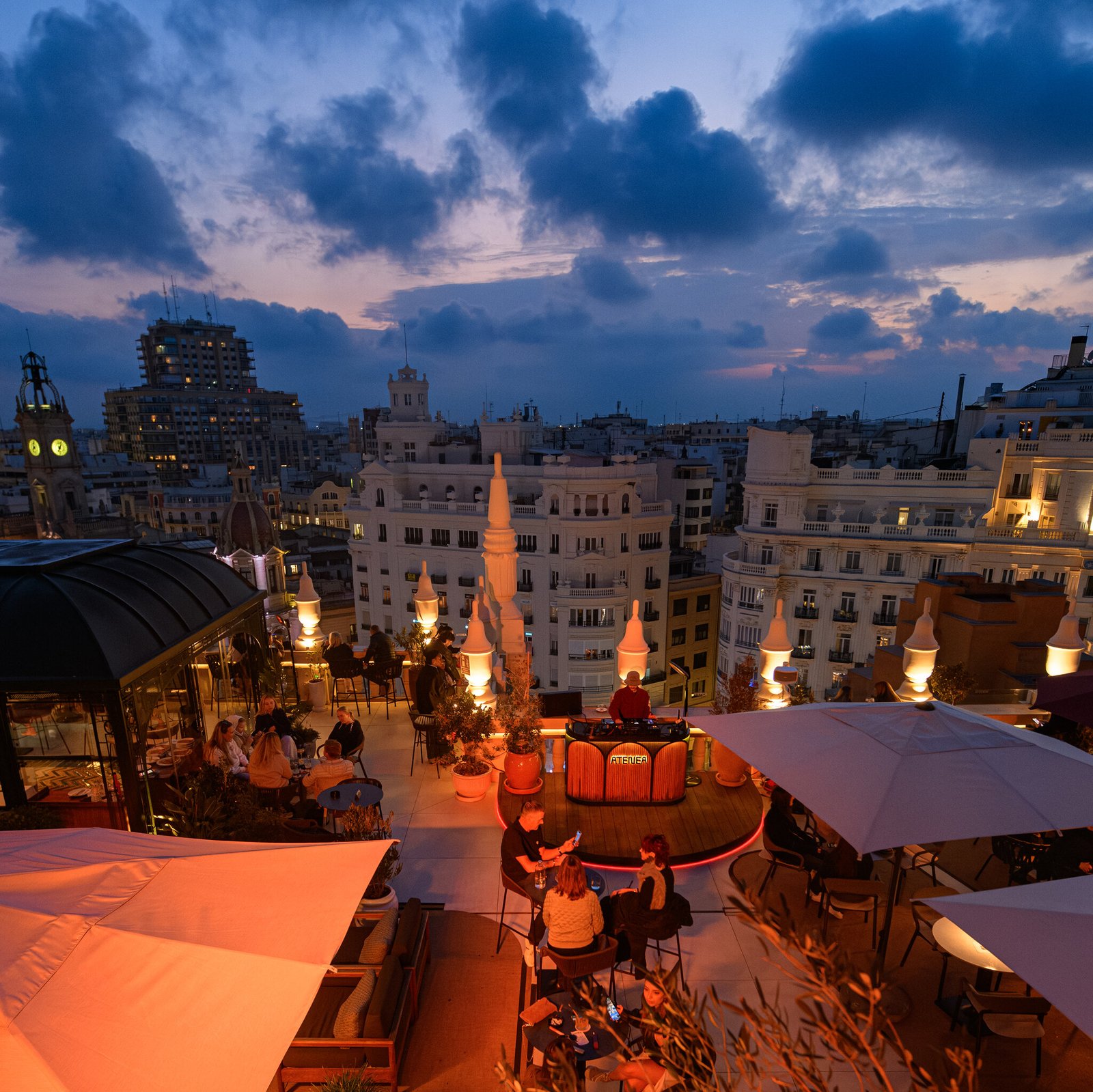
As the evening progresses, the festive energy around Conde de Altea keeps building. Maison Lupin offers a chic atmosphere for imbibing superbly made cocktails in fanciful ceramic drinking vessels. The local classic “Agua de Valencia” (gin, orange juice, Cointreau and cava) is served in a vivid orange duck-shaped glass. The bar’s namesake Arsène Lupin cocktail (vodka, lime and both watermelon syrup and watermelon juice) comes in a tall glass in the form of the elegant, monocle-wearing fictional gentleman thief created by the French author Maurice Leblanc in the early 1900s (cocktails, 12 euros). End the night at the casual vintage record shop and bar Splendini. For something a little more upscale and physically higher up, try the rooftop terrace at Atenea Sky, overlooking the grand plaza in front of the even grander City Hall.